Listening Test 04
Listening Workspace
|Part 1|
Questions 1–6
Complete the form below.
Write NO MORE THAN THREE WORDS OR A NUMBER for each answer.
HOMESTAY APPLICATION
| Example | Answer |
| Surname: | Yuichini |
| First name: (Q:1) {Keiko} | |
| Sex: female | Nationality: Japanese |
| Passport number: (Q:2) {JO6337} | Age: 28 years |
| Present address: Room 21C, Willow College | |
| Length of homestay: approx. (Q:3) {4 months} | |
| Course enrolled in: (Q:4) {English} | |
| Family preferences: | no (Q:5) {children} no objection to (Q:6) {pets} |
Questions 7–10
Answer the questions below.
Write NO MORE THAN TWO WORDS for each answer.
(Q:7) What does the student particularly like to eat?
{seafood}
(Q:8) What sport does the student play?
{tennis}
(Q:9) What mode of transport does the student prefer?
{trains}
(Q:10) When will the student find out her homestay address?
{this afternoon}
|Part 2|
Questions 11–14
Choose the correct letter, A, B or C.
(Q:11) What kind of tour is Sally leading?
[A. a bus tour.
/B. a train tour.
/*C. a walking tour.
]
(Q:12) The original buildings on the site were...
[A. houses.
/*B. industrial buildings.
/C. shops.
]
(Q:13) The local residents wanted to use the site for...
[*A. leisure.
/B. apartment blocks.
/C. a sports centre.
]
(Q:14) The Tower is at the centre of the...
[A. nature reserve.
/*B. formal gardens.
/C. Bicentennial Park.
]
Questions 15–17
Label the plan below.
Write NO MORE THAN TWO WORDS for each answer.
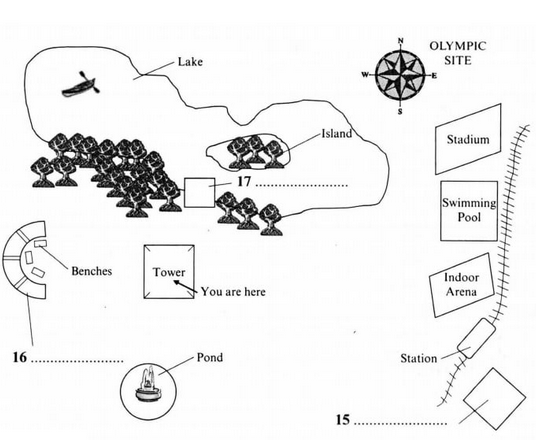
(Q:15) {car park} (Q:16) {rose garden} (Q:17) {cafe}
Questions 18–20
Complete the table below.
Write NO MORE THAN TWO WORDS for each answer.
Nature Reserve
| Area | Facility | Activity |
|---|---|---|
| The Mangrove | boardwalk | (Q:18) {cycling} |
| Frog Pond | outdoor classroom | (Q:19) {biology lesson} |
| The Waterbird Refuge | (Q:20) {viewing shelter} | Bird watching |
|Part 3|
Questions 21 and 22
Complete the sentences below.
Write NO MORE THAN ONE WORD AND/OR A NUMBER for each answer.
The presentation will last 15 minutes.
There will be (Q:21) {5 / five} minutes for questions.
The presentation will not be (Q:22) {assessed}.
Questions 23–26
What do the students decide about each topic for the geography presentation?
A They will definitely include this topic
B They might include this topic
C They will not include this topic
Choose your answers from the box and write the correct letter, A, B or C, next to questions 23–26.
(Q:23) [select: *A/B/C] Geographical Location
(Q:24) [select: A/*B/C] Economy
(Q:25) [select: *A/B/C] Overview of Education System
(Q:26) [select: A/B/*C] Role of English Language
Questions 27–30
Complete the table below. Write NO MORE THAN TWO WORDS for each answer.
| Information / visual aid | Where from? |
|---|---|
| Overhead projector | the (Q:27) {media room} |
| Map of West Africa | the (Q:28) {resources room} |
| Map of the islands | a tourist brochure |
| Literacy figures | the (Q:29) {embassy} |
| (Q:30) {statistics} on school places | as above |
|Part 4|
Questions 31–33
Choose the correct letter, A, B or C.
Monosodium Glutamate (MSG)
(Q:31) The speaker says the main topic of the lecture is...
[A. the history of monosodium glutamate.
/*B. the way monosodium glutamate works.
/C. where monosodium glutamate is used.
]
(Q:32) In 1908, scientists in Japan...
[A. made monosodium glutamate.
/B. began using kombu.
/*C. identified glutamate.
]
(Q:33) What change occurred in the manufacture of glutamate in 1956?
[*A. It began to be manufactured on a large scale.
/B. The Japanese began extracting it from natural sources.
/C. It became much more expensive to produce.
]
Questions 34–40
Complete the notes below.
Write NO MORE THAN TWO WORDS for each answer.
Monosodium Glutamate (MSG)
- MSG contains:
- Glutamate (78.2%)
- Sodium (12.2%)
- (Q:34) {water} (9.6%)
- Glutamate is found in foods that contain protein such as (Q:35) {meat}
and (Q:36) {cheese}.
- MSG is used in foods in many different parts of the world.
- In 1908 Kikunae Ikeda discovered a (Q:37) {new taste}.
- Our ability to detect glutamate makes sense because it is so (Q:38) {common} naturally.
- John Prescott suggests that:
- Sweetness tells us that a food contains carbohydrates.
- (Q:39) {bitterness} tells us that a food contains toxins.
- Saltiness tells us that a food contains (Q:40) {minerals}.
Collected Notes
Close Workspace?
Your current session progress will not be saved.