Listening Test 07
Listening Workspace
|Part 1|
Questions 1–6
Complete the table below.
Write NO MORE THAN ONE WORD AND/OR A NUMBER for each answer.
HOSTEL accommodation in Darwin
| Name | Price per person (dormitory rooms) | Comments and reviews |
|---|---|---|
| Top End Backpackers (Example) | $19 | • parking available • staff are (Q:1) {unfriendly} • nice pool • air-conditioning is too (Q:2) {noisy} |
| Gum Tree Lodge | $ (Q:3) {23.50|twenty-three fifty} | • good quiet location • pool and gardens • (Q:4) {insects} in the dormitories |
| Kangaroo Lodge | $22 | • downtown location • reception at the lodge is always open • no lockers in the rooms • the (Q:5) {bathrooms} are very clean • seems to be a (Q:6) {party} every night |
Questions 7–10
Complete the notes below.
Write ONE WORD ONLY for each answer.
Kangaroo Lodge
- Address: on (Q:7) {Shadforth} Lane
General information about hostel accommodation
- sheets are provided
- can hire a (Q:8) {towel}
- (Q:9) {breakfast} is included
- a shared (Q:10) {kitchen} is available
|Part 2|
Questions 11–16
Choose the correct letter, A, B or C.
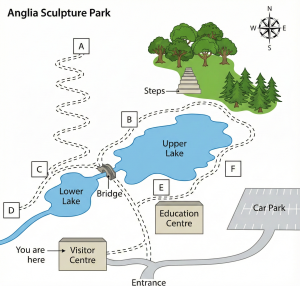
Anglia Sculpture Park
(Q:11) The land where the Sculpture Park is located was previously
[A. completely covered by forest./ *B. the site of a private house./ C. occupied by a factory.]
(Q:12) What is unusual about the Anglia Sculpture Park?
[*A. Artists have made sculptures especially for it./ B. Some of its sculptures were donated by the artists./ C. It only shows contemporary sculptures.]
(Q:13) What is the theme of Joe Tremain's 'burnt' sculptures?
[A. the contrast between nature and urban life./ B. the effect of man on the environment./ *C. the violence of nature.]
(Q:14) The path by the Lower Lake
[A. is rather wet in some places./ *B. has recently been repaired./ C. is difficult to walk on.]
(Q:15) What does the speaker say about the Visitor Centre?
[*A. It is being enlarged at present./ B. It has received an international award./ C. It was designed by a Canadian architect.]
(Q:16) Today, visitors can buy snacks and sandwiches
[*A. at the kiosk./ B. in the Terrace Room./ C. at the Lower Lake Café.]
Questions 17–20
Label the map below.
Write the correct letter, A–F, next to Questions 17–20.
|Part 3|
Questions 21–26
Choose the correct letter, A, B or C.
Marketing report
(Q:21) Why did Leo choose instant coffee as the topic for his marketing report?
[*A. He found plenty of material on the topic./ B. He had some practical experience in the area./ C. He had an idea of a brand he wanted to target.]
(Q:22) Leo discovered that in Australia, recent technological developments
[A. are producing less healthy types of instant coffee./ *B. are reducing the demand for instant coffee./ C. are improving the quality of instant coffee.]
(Q:23) What do the speakers agree about Leo's table of coffee products?
[*A. It needs more explanation in the text./ B. It is factually inaccurate in some places./ C. It would be best to put this in the appendix.]
(Q:24) What do they decide about the description of Shaffers coffee as a market follower?
[A. Leo needs to define his terms./ *B. Leo needs to provide more evidence./ C. Leo needs to put it in a different section.]
(Q:25) What does Anna say about originality in someone's first marketing report?
[*A. Clear analysis of data can be considered original./ B. Graphs and diagrams should be original, not copied./ C. Reports should contain some original data collected by the student.]
(Q:26) What difference between his school assignments and this report has surprised Leo?
[*A. not knowing the criteria for getting a good mark./ B. being required to produce work without assistance./ C. having to do a great deal of research.]
Questions 27–30
Complete the notes below.
Write ONE WORD ONLY for each answer.
Notes on specific sections of marketing report
Executive summary
- Give a brief overview including the (Q:27) {background}
Problems
- Link each problem to a (Q:28) {theory} which explains it
Implementation
- Practical solutions to problems
- Include details such as participants, (Q:29) {cost|costs} and sequence
- Section is often poorly done because of lack of (Q:30) {time}
|Part 4|
Questions 31–40
Complete the notes below.
Write ONE WORD ONLY for each answer.
History of Fireworks in Europe
13th–16th centuries
- Fireworks were introduced from China.
- Their use was mainly to do with:
- war
- (Q:31) {religion|religions} (in plays and festivals)
17th century
- Various features of (Q:32) {nature} were shown in fireworks displays.
- Scientists were interested in using ideas from fireworks displays:
- to make human (Q:33) {flight} possible
- to show the formation of (Q:34) {stars}
- London: Scientists were distrustful at first; later, they investigated (Q:35) {practical} uses of fireworks (e.g. for sailors)
- St Petersburg: Fireworks were seen as a method of (Q:36) {education} for people
- Paris: Displays emphasised the power of the (Q:37) {king}; scientists aimed to provide (Q:38) {entertainment}
18th century
- Italian fireworks specialists became influential.
- Servandoni's fireworks display followed the same pattern as an (Q:39) {opera}
- The appeal of fireworks extended to the middle classes.
- Some displays demonstrated new scientific discoveries such as (Q:40) {electricity}
Collected Notes
Close Workspace?
Your current session progress will not be saved.