Listening Test 01
Listening Workspace
|Part 1|
Questions 1–4
Complete the notes below. Write NO MORE THAN THREE WORDS AND/OR A NUMBER for each answer.
NOTES ON SOCIAL PROGRAMME
Visit places which have:
• historical interest
(Q:1) • good {shopping}
(Q:2) • {guided tours}
Cost: between £5.00 and £15.00 per person
(Q:3) Note: special trips organised for groups of {more than 12} people
Time: departure – 8.30 a.m and return – 6.00 p.m.
(Q:4) To reserve a seat: sign name on the {notice board} 3 days in advance
Questions 5–10
Complete the table below. Write NO MORE THAN THREE WORDS AND/OR A NUMBER for each answer.
Write NO MORE THAN THREE WORDS AND/OR A NUMBER for each answer.
WEEKEND TRIPS | |||
Place | Date | Number of seats | Optional extra |
St Ives | (Q:5) {A} | 16 | Hepworth Museum |
London | 16th February | 45 | (Q:6) {A} |
(Q:7) {A} | 3rd March | 18 | S.S. Great Britain |
Salisbury | 18th March | 50 | Stonehenge |
Bath | 23rd March | 16 | (Q:8) {A} |
For further information:
| |||
|Part 2|
Questions 11–13
Complete the sentences below. Write NO MORE THAN THREE WORDS AND/OR A NUMBER for each answer.
RIVERSIDE INDUSTRIAL VILLAGE
(Q:11) Riverside Village was a good place to start an industry because it had water, raw materials and fuels such as {coal} and {firewood}
(Q:12) The metal industry was established at Riverside Village by {local craftsmen} who lived in the area.
(Q:13) There were over {160} water-powered mills in the area in the eighteenth century.
Questions 14–20
Complete the plan below. Write NO MORE THAN TWO WORDS for each answer.
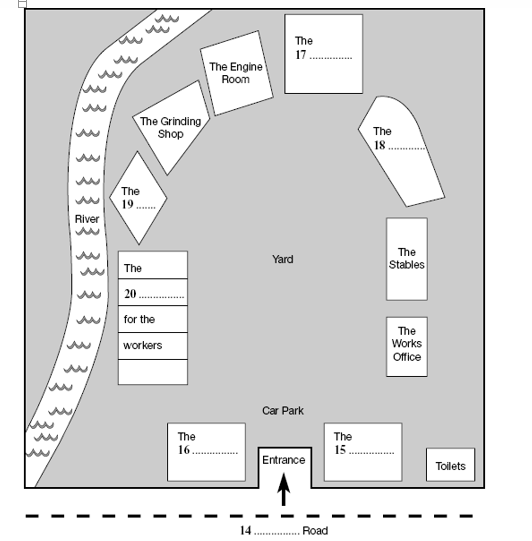
- (Q:14) {A} Road
- The (Q:15) {A}
- The (Q:16) {A}
- The (Q:17) {A}
- The (Q:18) {A}
- The (Q:19) {A}
- The (Q:20) {A} for the worker
|Part 3|
Questions 21 and 22
Choose the correct letter A, B or C.
(Q:21) Melanie says she has not started the assignment because...
[*A. she was doing work for another course./B. it was a really big assignment./C. she hasn’t spent time in the library.]
(Q:22) The lecturer says that reasonable excuses for extensions are...
[A. planning problems./B. problems with assignment deadlines./*C. personal illness or accident.]
Questions 23–27
What recommendations does Dr Johnson make about the journal articles? Choose your answers from the box and write the letters A–G next to questions 23–27.
A must read
B useful
C limited value
D read first section
E read research methods
F read conclusion
G don’t read
(Q:23) Jackson [select: A/B/C/D/*E/F/G]
(Q:24) Roberts [select: A/*B/C/D/E/F/G]
(Q:25) Morris [select: A/B/C/D/E/F/*G]
(Q:26) Cooper [select: A/B/C/D/E/*F/G]
(Q:27) Forster [select: A/B/*C/D/E/F/G]
Questions 28–30
Label the chart below. Choose your answers from the box and write the letters A–H next to questions 28–30.
Possible reasons:
A. uncooperative landlord | B. environment | C. space | D. noisy neighbours
E. near city | F. work location | G. transport | H. rent
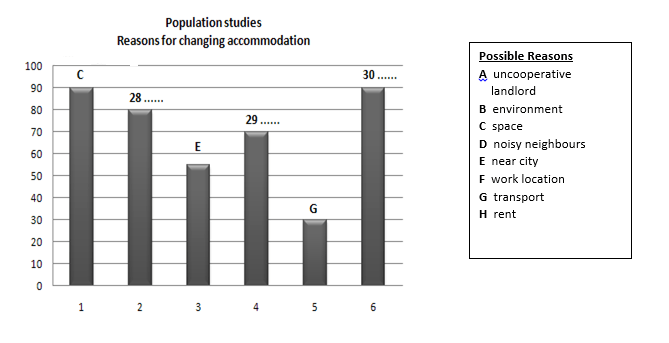
(Q:28) 28: [select: A/B/C/*D/E/F/G/H]
(Q:29) 29: [select: *A/B/C/D/E/F/G/H]
(Q:30) 30: [select: A/*B/C/D/E/F/G/H]
|Part 4|
QUESTIONS 31-40
Complete the notes below. Write NO MORE THAN TWO WORDS for each answer.
THE URBAN LANDSCAPE
Two areas of focus:
• the effect of vegetation on the urban climate
• ways of planning our (Q:31) {cities} better
Large-scale impact of trees:
• they can make cities more or less (Q:32) {windy}
• in summer they can make cities cooler
• they can make inland cities more (Q:33) {humid}
Local impact of trees:
• they can make local areas:
– more (Q:34) {shady}
– cooler
– more humid
– less windy
– less (Q:35) {dangerous}
Comparing trees and buildings:
Temperature regulation:
• trees evaporate water through their (Q:36) {leaves}
• building surfaces may reach high temperatures
Wind force:
• tall buildings cause more wind at (Q:37) {ground} level
• trees (Q:38) {reduce} the wind force
Noise:
• trees have a small effect on traffic noise
• (Q:39) {low} frequency noise passes through trees
Important points to consider:
• trees require a lot of sunlight, water and (Q:40) {space} to grow
Collected Notes
Close Workspace?
Your current session progress will not be saved.