Reading Test 01
Reading Workspace
|Part 1|
AIRCONDITIONING THE EARTH
The circulation of air in the atmosphere is activated by convection, the transference of heat resulting from the fact that warm gases or fluids rise while cold gases or fluids sink. For example, if one wall of a room is heated whilst the opposite wall is cooled, air will rise against the warm wall and flow across the ceiling to the cold wall before descending to flow back across the floor to the warm wall again. The real atmosphere, however, is like a very long room with a very low ceiling.
The distance from equator to pole is 10,000 km, while the ‘ceiling height’ to the beginning of the stratosphere is only about 10 km. The air therefore splits up into a number of smaller loops or convection cells. Between the equator and each pole there are three such cells and within these the circulation is mainly north-south.
Large-scale air-conditioning
The result of this circulation is a flow of heat energy towards the poles and a levelling out of the climate so that both equatorial and polar regions are habitable. The atmosphere generally retains its state of equilibrium as every north-going air current is counterbalanced by a south-going one. In the same way depressions at lower levels in the troposphere are counterbalanced by areas of high pressure in the upper levels, and vice versa. The atmospheric transference of heat is closely associated with the movement of moisture between sea and continent and between different latitudes. Moist air can transport much greater quantities of energy than dry air.
Because the belts of convection cells run east to west, both climate and weather vary according to latitude. Climatic zones are particularly distinguishable at sea where there are no land masses to disturb the pattern.
Man and the winds
For thousands of years mankind has been dependent upon the winds: they brought rain to the land and carried ships across the seas. Thus the westerly wind belts, the trade winds and the monsoon winds of the global circulation systems have been known to us for many centuries.
As recently as the 20th century, Arab ships sailed on the south-west monsoon winds from East Africa to India and back again on the north-east monsoon winds, without need of a compass. The winds alone were sufficient. In the equatorial convergence zone (the ‘doldrums’), and in the regions around the Tropic of Cancer and Tropic of Capricorn known as the ‘horse latitudes’, sailing ships could drift for weeks unable to steer, while the ‘roaring forties’ of the South Atlantic (40-50°S) were notorious among mariners for their terrible winds.
It was not until the development of the balloon at the end of the 18th century, however, that it became possible to study meteorological conditions at high altitudes. The balloon is still a significant research device although today it carries a radar reflector or a set of instruments and a radio transmitter, rather than the scientists themselves. Nowadays high-flying aircraft and satellites are also important aids to meteorology. Through them we have discovered the west to east jet stream. This blows at speeds of up to 500 km/h at altitudes of 9,000-10,000 m along the border between the Arctic and temperate zone convection belts.
Weather fronts
The circulation within the different convection cells is greater than the exchange of air between them and therefore the temperature in two cells that are close to each other can differ greatly. Consequently, the borders between the different convection cells are areas in which warm and cold air masses oppose each other, advancing and withdrawing. In the Northern Hemisphere, the dividing line between the Arctic and temperate convection zones is the polar front, and it is this which determines the weather in northern Europe and North America. This front is unstable, weaving sometimes northward, sometimes southward, of an average latitude of 60°N. Depressions become trapped within the deep concavities of this front and these subsequently move eastward along it with areas of rain and snowfall. In this way global air circulation determines not only the long-term climate but also the immediate weather.
|Part 2|
MONEY AS THE UNIT OF ACCOUNT
SECTION A
The most difficult aspect of money to understand is its function as a unit of account. In linear measurement we find the definition of a yard, or a metre, easy to accept. In former times these lengths were defined in terms of fine lines etched onto brass rods maintained in standards laboratories at constant temperatures. Money, however, is much more difficult to define because the value of anything is ultimately in the mind of the observer, and such values will change with time and circumstance.
Sir Isaac Newton, as Master of the Royal Mint, defined the pound sterling (£) in 1717 as 113 grains of pure gold. This took Britain off silver and onto gold as defining the unit of account. The pound was 113 grains of pure gold, the shilling was 1/20 of that, and the penny 1/240 of it.
By the end of the 19th century the gold standard had spread around most of the trading world, with the result that there was a single world money. It was called by different names in different countries, but all these supposedly different currencies were rigidly interconnected through their particular definition in terms of a quantity of gold.
SECTION B
In economic life the prices of different commodities and services are always changing with respect to each other. If the potato crop, for example, is ruined by frost or flood, then the price of potatoes will go up. The consequences of that particular price increase will be complex and unpredictable. Because of the high price of potatoes, prices of other things will decline, as demand for them declines. Similarly, the argument that the Middle East crisis following the Iraqi annexation of Kuwait would, because of increased oil prices, have led to sustained general inflation is, although widely accepted, entirely without foundation. With sound money (money whose purchasing power does not decline over time) a sudden price shock in any one commodity will not lead to a general price increase, but to changes in relative prices throughout the economy. As oil increases, other goods and services will drop in price, and oil substitutes will rise in price, as the consequences of the oil price increase work their unpredictable and complex way through the economy.
The use of gold as the unit of account during the days of the gold standard meant that the price of all other commodities and services would swing up and down with reference to the price of gold, which was fixed. If gold supplies diminished, as they did when the 1850s gold rushes in California and Australia were finishing, then deflation (a general price level decrease) would set in. When new gold rushes followed in South Africa and again in Australia, in the 1880s and 1890s, the general price level increased, gently, around the world, as there was more money in circulation.
SECTION C
The end of the gold standard began with the introduction of the Bretton-Woods Agreement in 1946. This fixed the value of all world currencies relative to the US dollar, which in turn was fixed to a specific value of gold (US$0.35/oz). However, in 1971 the US government finally refused to exchange US dollars for gold, and other countries soon followed. Governments printed as much paper money or coinage as they wanted, and the more that was printed, the less each unit of currency was worth.
The key problem with these government ‘fiat’ currencies is that their value is not defined; such value is subject to how much money a government cares to print. Their future value is unpredictable, depending as it does on political chance. In past economic calculations of the Australian Institute for Public Policy, incomes and expenditures were automatically converted to dollars of a particular year, using CPI deflators, which are stored in the Institute’s computers. When the Institute performs economic calculations into the future, it guesses at inflation rates and includes these guesses in its figures. The guesses are entirely based on past experience. In Australia most current calculations assume a three to four per cent inflation rate.
SECTION D
The great advantage of the 19th century gold standard was not just that it defined the unit of account, but that it operated throughout almost the entire world. Anthony Trollope tells us in his diaries about his Australian travels in 1872 that a pound of meat, selling in Australia for two pence, would have cost ten pence or even a shilling in the UK. It was this price difference which drove investment and effort into the development of shipboard refrigeration, and opening up of major new markets for Australian meat, at great benefit to the British public.
Today we can determine price differences between countries by considering the exchange rate of the day. In twelve months’ time, even a month’s time, however, a totally different situation may prevail, and investments of time and money made on the basis of an opportunity at an exchange rate of the day, may actually perform poorly because of subsequent exchange rate movements.
The great advantage of having a single stable world currency is that such currency would have very high information content. It tells people where to invest their time, energy and capital, all around the world, with much greater accuracy and predictability than would otherwise be possible.
|Part 3|
CHEMISTRY OF CRUDE OIL
Chemically, petroleum is a complex mixture of hydrocarbons (compounds of hydrogen and carbon), with varying amounts of sulphur, nitrogen, oxygen, and traces of some metallic elements appearing in the molecules. Since different groups of hydrocarbons can be used for different purposes (eg. gasoline, kerosene, lubricating oil), the crude petroleum is refined to separate them out. Most petroleum products contain a range of hydrocarbons, and are defined by their boiling range and specific gravity.
Distillation
Distillation was the first method of refining petroleum to be used. Crude oil was placed in horizontal cylindrical stills holding from 100 to 1000 barrels, heat was applied to the bottom of the still, and, at a still-head vapour temperature of about 38°C, light hydrocarbons were distilled and condensed in a pipe coil immersed in a tank of water. As the vapour temperature increased, gasoline was distilled and the condensed vapours were allowed to flow into a receiving tank. When a temperature of about 177°C was reached and a test showed that the specific gravity of the condensate has reached a chosen point, the stream of condensate was directed to a different tank and distillation progressed to a vapour temperature of about 230°C to 260°C to produce a kerosene fraction. When tests showed that the kerosene had all been recovered, the condensate again was diverted to another tank and distillation was continued to produce light fuel-oil distillate, boiling up to about 340°C to 370°C. From this point on, distillation was usually helped by the introduction of steam under the surface so that the partial pressure of the oil vapour was lessened and the temperature of distillation was reduced. This technique was used because the heavier portions of crude oil boiling above light fuel-oil distillates begin to decompose into lighter fractions, or "cracks", at about 405°C with a negative effect on the succeeding distillates and the residual oil in the still.
The early distillation processes were inefficient because no sharp separations of distillate products were obtained. Gasoline contained some kerosene, and kerosene contained both gasoline and higher-boiling distillates belonging in the fuel-oil category. To correct some of this overlapping, redistillation of the primary fractions was practised, sometimes with steam and sometimes with short fractionation columns filled with coarse gravel, lump silica, or other inert materials.
Thermal Cracking
The tendency of the heavier portions of crude petroleum to decompose when they are heated above a certain temperature has been put to a most important commercial use in the cracking process. When the higher-boiling fractions of petroleum decompose, carbon-to-carbon bonds are broken and hydrogen is split off from hydrocarbon molecules so that a greater spread of products is obtained than was present in the original crude oil. Cracking makes it possible to increase the yield of gasoline from crude oil by cracking the heavier distillates and residuum left after primary distillation.
Controlled thermal cracking was first applied commercially in 1913. A gas oil distillate was distilled under a pressure of about 520 kilopascals at a temperature of about 400°C. A yield of about 35 per cent of cracked gasoline was obtained. Cracking was continued until the gasoline production waned. The commercialisation of the cracking process was made necessary by the rapid growth in popularity of the automobile and the ever-growing need for gasoline to fuel it. The problem to refiners was one of increasing the ratio of gasoline to crude oil refined, or else accumulating enormous stocks of other petroleum products that could not be sold.
Catalytic Cracking
As the use of the automobile in the United States expanded, thermal refining processes were unable to yield both the quantity and quality of gasoline needed from a barrel of crude oil. Refiners turned to another technique for increasing yields of gasoline and other light fuels. This process is catalytic cracking.
The first commercially successful catalytic cracking process was developed in the 1930s. In it, granular or pelleted clay particles were used as a catalyst in the cracking chambers. Intermediate-boiling-range petroleum distillates were heated and vapourised and passed through a bed of catalyst to increase the rate of cracking and modify the character of the cracking reactions. Moderate temperatures of from 430° to 480°C were employed, at atmospheric pressure, as opposed to the high pressures of thermal cracking processes.
A further development was the fluid catalytic cracking process, in which finely powdered catalyst was fed into the preheated oil vapours in heavy concentration, so there would be close contact between catalyst and oil vapours in the cracking chambers. The catalyst was carried out of the cracking chamber by the cracked vapours and separated in cyclone separators. It was then purified and returned for further use. The finely powdered catalyst exposed enormously greater surface area than did the pelleted catalyst, hence the improvement in cracking efficiency compared to the original process. The movement of the powdered catalyst inside the reactor and regenerators is accomplished without any interior moving parts and hence no problems of mechanical wear or lubrication of pumps, compressors, valves or other components are encountered.
In the recent past, developments in catalytic cracking have occurred on several fronts. The most significant was the introduction in 1962 of catalysts containing zeolites. The greater activity and selectivity of these (“sieve”) catalysts make it possible to obtain much higher yields of gasoline fractions - as much as 20 to 30 per cent in some units - than was possible with conventional silica-alumina types.
Glossary: Catalyst: a substance that promotes chemical change without itself changing. Many substances, including metals, metal oxides, and various salts, show catalytic properties.
|Part 1|
Questions 1–3
Complete the diagram below. Choose NO MORE THAN THREE WORDS OR A NUMBER from the passage for each answer.
Diagram of Earth's Atmosphere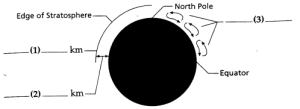
Distance from Equator to Pole: (Q:1) {10,000} km
Height of the Stratosphere "Ceiling": (Q:2) {10} km
The air splits into smaller loops called: (Q:3) {convection cells}
Questions 4–7
Complete the paragraph below using words and phrases from the box. Write your answers in boxes 4–7.
Global air circulation spreads heat from the (Q:4) [select: on land/equatorial regions/heat/in the air/mountainous regions/latitude/*polar regions/at sea/moisture/depressions/coastal regions/longitude] towards the (Q:5) [select: on land/*equatorial regions/heat/in the air/mountainous regions/latitude/polar regions/at sea/moisture/depressions/coastal regions/longitude].
Within this system of heat transfer, climate is affected not only by (Q:6) [select: on land/equatorial regions/heat/in the air/mountainous regions/*latitude/polar regions/at sea/moisture/depressions/coastal regions/longitude] but also by the amount of moisture in the air.
The most accurate geographical zone in which to study climate is (Q:7) [select: on land/equatorial regions/heat/in the air/mountainous regions/latitude/polar regions/*at sea/moisture/depressions/coastal regions/longitude] where there are no local wind systems.
Word List:
on land | equatorial regions | heat | in the air | mountainous regions | latitude | polar regions | at sea | moisture | depressions | coastal regions | longitude
Questions 8–11
Several different wind patterns are mentioned in the passage. For each of the patterns below, write a letter in the boxes.
U if the passage states that the patterns are useful
P if the passage states that the patterns present problems
N if the passage does not state whether the patterns are useful or problematic
(Q:8) West to east jet stream [select: U/P/*N]
(Q:9) The roaring forties [select: U/*P/N]
(Q:10) The horse latitudes [select: U/*P/N]
(Q:11) North-east monsoon winds [select: *U/P/N]
Questions 12–13
Choose the correct letter A, B or C.
(Q:12) Convection cells near to each other [list:A. usually have similar temperatures
/B. usually have slightly different temperatures/*C. may have extremely different temperatures]
(Q:13) The borders between convection cells [list: A. are always in the same place
/*B. may move forwards and backwards /C. are totally unpredictable in their position]
|Part 2|
Questions 14–17
Choose the most suitable heading for each section from the list of headings below.
List of Headings
i. the price of gold
ii. the notion of money and its expression
iii. the rise of problematic modern currencies
iv. stable money compared to modern “fiat” currencies
v. the effects of inflation
vi. the interrelationship of prices
(Q:14) SECTION I: [select: i/*ii/iii/iv/v/vi]
(Q:15) SECTION II: [select: i/ii/iii/iv/v/*vi]
(Q:16) SECTION III: [select: i/ii/*iii/iv/v/vi]
(Q:17) SECTION IV: [select: i/ii/iii/*iv/v/vi]
Questions 18–21
Using information from the text, match the following causes with a result. Write the appropriate letters in boxes 18–21 on your answer sheet.
| CAUSE | RESULT |
|---|---|
(Q:18) 18. The price of potatoes goes up. [select: A/B/C/D/*E/F/G/H/I] | A Oil substitutes become more expensive. |
B Oil substitutes drop in price. | |
(Q:19) 19. The amount of gold available went up. [select: A/B/C/D/E/F/*G/H/I] | C People developed techniques of transporting it to other places. |
(Q:20) 20. The amount of gold available went down. [select: A/B/C/D/E/F/G/H/*I] | D More people went to live in Australia. |
(Q:21) 21. Meat in Australia was cheaper than elsewhere. [select: A/B/*C/D/E/F/G/H/I] | E The price of other things goes down, because fewer people could afford to buy them. |
F People used gold instead of silver as money. | |
G All prices went up slightly, everywhere. | |
H There is no observable effect. | |
I All prices went down, everywhere. |
Questions 22–26
Using the information in the passage, match a phrase A, B, or C in List 1 with the statements in List 2 to show which kind of money is meant.
List 1
A. Money based on a gold standard
B. Government fiat monopoly currencies
C. Both money based on a gold standard and fiat currencies
(Q:22) The writer states that it has a clearly defined value. [select: *A/B/C]
(Q:23) The writer states that its value by definition varies over time. [select: A/*B/C]
(Q:24) The writer describes its future value as predictable. [select: *A/B/C]
(Q:25) The writer knows or can calculate its past value. [select: A/B/*C]
(Q:26) The writer believes it makes international investment easier. [select: *A/B/C]
|Part 3|
Questions 27–30
Label the shaded areas on the graph to show what is produced or what event takes place at the different temperatures. Write NO MORE THAN THREE WORDS for each answer.
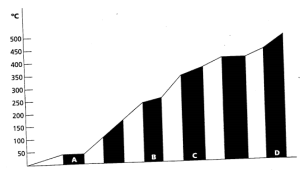
(Q:27) Shading A: {light hydrocarbons}
(Q:28) Shading B: {(a) kerosene (fraction) / kerosene}
(Q:29) Shading C: {(light) fuel-oil distillate / fuel-oil distillate}
(Q:30) Shading D: {catalytic cracking / cracking}
Questions 31–34
Label the following diagrams using words and phrases from the box below.
Note: there are more words and phrases in the box than you will need. ANy word and phrase may be used more than once. Write the answers in boxes 31-34 on your answer sheet.
thermal cracking | catalyst in powder | distillation | redistillation
catalyst separated out | catalyst in pellets | heavy distillates | catalyst purified
hydrogen separated out | kerosene recovered
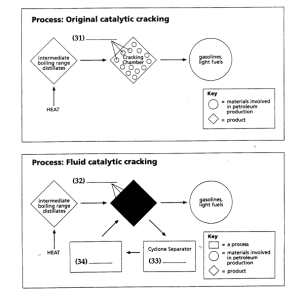
(Q:31) In the original catalytic cracking chamber, granular or pelleted particles are used as: {catalyst in pellets}
(Q:32) In the fluid catalytic cracking process, the material fed into preheated oil vapours is: {catalyst in powder}
(Q:33) Inside the cyclone separator, the following product is found: {catalyst separated out}
(Q:34) Before being returned for further use, the catalyst is: {catalyst purified}
Questions 35–40
Complete the following sentences using information from the text. Use NO MORE THAN THREE WORDS for each answer.
(Q:35) Petroleum products are recognised by their {boiling range} and specific gravity.
(Q:36) In the early days of the petroleum industry, it was often necessary to distill products a second time to {separate} them properly.
(Q:37) Cracking is carried out after {primary distillation}.
(Q:38) The process of cracking uses {heavy distillates / heavier distillates} and residuum.
(Q:39) Catalytic cracking is carried out at {atmospheric} pressure.
(Q:40) New catalysts have improved the gasoline yield per barrel by {20 to 30} %.
Collected Notes
Close Workspace?
Your progress will not be saved if you exit now.